Table of Contents

Related Content

Beyond the "Big Three": Breaches, AI, and the Hidden DPDP Rules

Watch our webinars
No items found.

Stopping Personal Data Sprawl: Centralized Governance with Skyflow for DPDP Rules 3 & 14 Compliance


January 23, 2026

(This is Part 3 of our Blog Series: DPDP Act and Rules Preparedness with Skyflow. To get the full download, read our whitepaper here. Or to get a few quick insights, read the other parts of the blogs starting here)

Taming the Operational Beast: Automated Compliance for Rules 3 & 14

Topic: How centralized governance solves the operational challenges of Consent (Rule 3) and Data Principal Rights (Rule 14).

While Rule 6 focuses on security, Rule 3 (Consent) and Rule 14 (Data Principal Rights) are about operational control. These rules demand that Data Fiduciaries have god-like visibility into their data, a capability that most fragmented enterprise architectures simply do not possess.

The Challenge: Operationalizing User Rights

Rule 3 mandates that consent must be itemized, specific, and easily revocable. Crucially, if a user withdraws consent, you must cease processing that data everywhere, including at your third-party processors, "within a reasonable time".

Rule 14 gives users the right to correct or erase their data. In a sprawled environment, erasing a user’s phone number means manually hunting it down in logs, backups, marketing tools, and analytics tables. This process is slow, expensive, and prone to human error.

Skyflow’s Answer: Centralized Governance

Skyflow solves this by centralizing the personal data and the governance logic in the Vault.

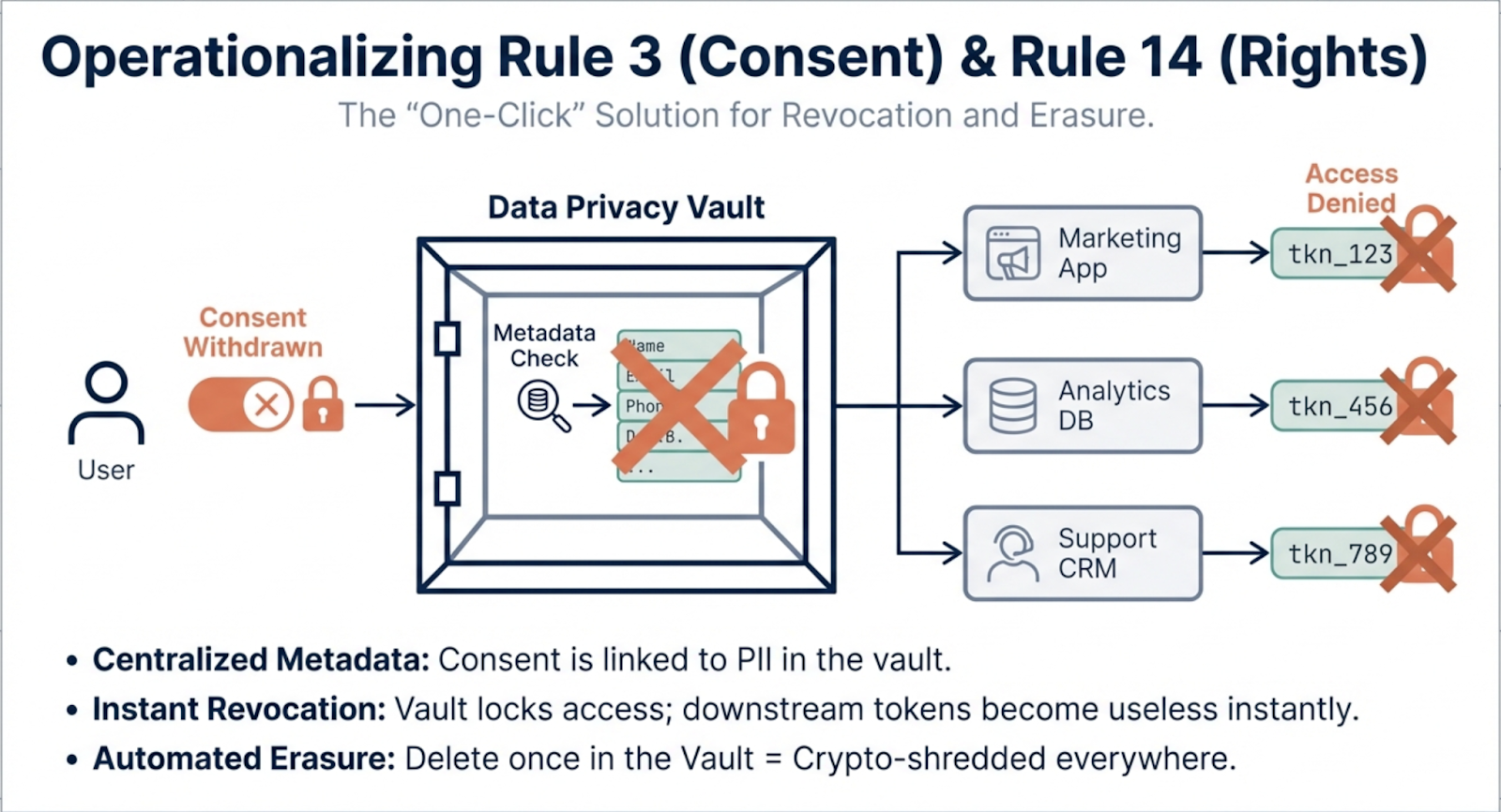
  1. Solving Rule 3 with Real-Time Validation Skyflow stores consent metadata (what was agreed to, for how long) directly alongside the sensitive data. Before any application accesses the data, the Vault checks this metadata. If a user revokes consent, the Vault instantly blocks access to that data globally. You don't need to update 50 systems; you just update the Vault, and the "processing" stops immediately.
  2. Solving Rule 14 with API-Driven Erasure Because the personal data exists in only one place (the Vault), fulfilling a "Right to Erasure" request becomes a single API call. Skyflow deletes the record in the Vault, rendering the tokens in your downstream systems useless. The data is effectively destroyed across your entire stack instantly, making you audit-ready without the manual chase.
Compliance with Rules 3 and 14 shouldn't be a manual campaign. Learn how to automate it in our detailed whitepaper.

Related Content

Compliance
Data Governance
Data Privacy & Security
Compliance

Beyond the "Big Three": Breaches, AI, and the Hidden DPDP Rules

Related Content

Beyond the "Big Three": Breaches, AI, and the Hidden DPDP Rules

Stopping Personal Data Sprawl: Centralized Governance with Skyflow for DPDP Rules 3 & 14 Compliance

January 23, 2026

(This is Part 3 of our Blog Series: DPDP Act and Rules Preparedness with Skyflow. To get the full download, read our whitepaper here. Or to get a few quick insights, read the other parts of the blogs starting here)

Taming the Operational Beast: Automated Compliance for Rules 3 & 14

Topic: How centralized governance solves the operational challenges of Consent (Rule 3) and Data Principal Rights (Rule 14).

While Rule 6 focuses on security, Rule 3 (Consent) and Rule 14 (Data Principal Rights) are about operational control. These rules demand that Data Fiduciaries have god-like visibility into their data, a capability that most fragmented enterprise architectures simply do not possess.

The Challenge: Operationalizing User Rights

Rule 3 mandates that consent must be itemized, specific, and easily revocable. Crucially, if a user withdraws consent, you must cease processing that data everywhere, including at your third-party processors, "within a reasonable time".

Rule 14 gives users the right to correct or erase their data. In a sprawled environment, erasing a user’s phone number means manually hunting it down in logs, backups, marketing tools, and analytics tables. This process is slow, expensive, and prone to human error.

Skyflow’s Answer: Centralized Governance

Skyflow solves this by centralizing the personal data and the governance logic in the Vault.

  1. Solving Rule 3 with Real-Time Validation Skyflow stores consent metadata (what was agreed to, for how long) directly alongside the sensitive data. Before any application accesses the data, the Vault checks this metadata. If a user revokes consent, the Vault instantly blocks access to that data globally. You don't need to update 50 systems; you just update the Vault, and the "processing" stops immediately.
  2. Solving Rule 14 with API-Driven Erasure Because the personal data exists in only one place (the Vault), fulfilling a "Right to Erasure" request becomes a single API call. Skyflow deletes the record in the Vault, rendering the tokens in your downstream systems useless. The data is effectively destroyed across your entire stack instantly, making you audit-ready without the manual chase.

Compliance with Rules 3 and 14 shouldn't be a manual campaign. Learn how to automate it in our detailed whitepaper.